Loading... Please wait...

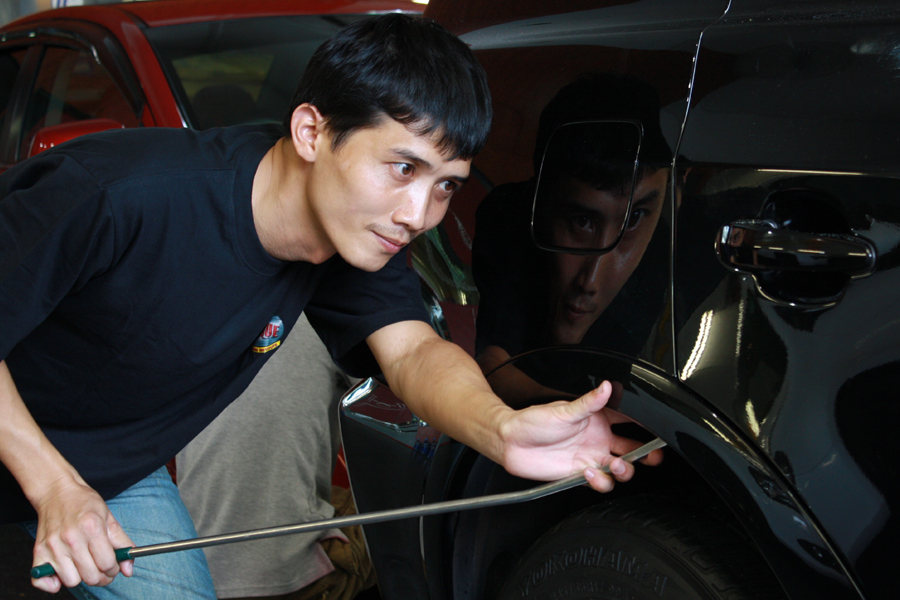 Paintless Dent Removal Training
The paintless dent repair business is an extremely attractive one because of the high rates that you can charge with relatively no cost. But don’t be fooled, because there is a very steep learning curve and the dent repair techs earning the top rates put in tens of thousands of hours of work to get to the top.
If you’re looking to get a foot in the door, you have three basic options for getting started.
Option 1: Dent Repair Schools
Pros: There are plenty of paintless dent repair schools in the country. They do a very good job of giving you an important understanding of the fundamentals of dent repair. They will show you in a structured environment how to remove basic dents without damaging the panel. They also do a very good job of giving you the opportunity to fix a few dents yourself in the presence of an instructor. There is no substitute for actually feeling the tools and, frankly, making mistakes on sample panels.
Negatives: However, the problem with structured school environments, is that you typically only work on the very easiest and most obvious dents. The sort of dents that you encounter in the real world are more complicated: access is difficult, you may not be able to achieve a complete repair, and some dents should just be turned away. So ultimately, you leave your school environment with an unrealistic idea of real-world dent repair.
Option 2: Study at Home Course
Pros: There are a variety of study at home courses which involve videos…most for sale on eBay. The great advantage to this is that you won’t have to travel, and you may invest no more than $50 on your dent repair videos. Buy some sample panels from a wrecking yard, set them up in your living room and go about watching and experimenting as you watch your instructor on your television. This is a very convenient study option.
Negatives: The big problem, of course, is that your instructor won’t be able to give you feedback. You will be struggling with your dents and nobody with experience can watch your process and identify the mistakes that you’re making. You could certainly fix the very easiest of dents with a very basic study at home course, but to move on to the more advanced dents that you get paid to fix in the real world, you’re going to need some feedback from an experienced paintless dent repair tech.
Option3: Look over the shoulder
Pros: Learning one-on-one from a practicing paintless dent repair technician on his route is perhaps the most valuable training you can receive. They’re so much more to dent repair than actually fixing dents. You have to go out and sell the service. Some dents have to be forwarded on to body shops. You have to take on challenging dents that push your limits. Every day, something goes wrong on your route, and to be there with an actual paintless dent repair tech following him around for a week is an absolute true look into the daily life of a paintless dent repair technician.
Negatives: But, it can be very hard to find a paintless dent repair technician willing to take you under his wing. It will be almost impossible to locate somebody in your city willing to do this. However if you drive more than an hour in any direction you may be able to pay a technician a fair sum to follow him around for a week. Eddie Martin of San Diego is one PDR tech who actually offers structured school-style PDR training and takes you along on his retail repair route.
The ultimate teacher.
Ultimately, no matter which option you choose you’re going to learn your skills in the field, making mistakes, and having triumphs. Everybody started at the bottom, and the way they reach the top was through repetition. So no matter what course you choose to get started, the very most important learning will happen in your first 6 to 12 months in the field. Frankly, you’re going to have to work for reduced rates at small car dealers selling cars for less than $4000 to really get any kind of experience. You may only make $50 a day. But in the long run, you are on the road to a lucrative career if you put in the work.
Make $100s more every day with our equipment.
Our paint touch up, alloy wheel repair, and leather & vinyl recoloring systems make it easy to offer the services your customers are asking for:
- Learn at home with DVD training.
- Explore opportunities without risk: 45 day 100% money back guarantee.
- Free phone support.